The migration has been located around the southern Serengeti for the past couple of months. The heavy rains in the past few weeks heralds the start of the calving season.
The herds are based from the outer Ngorongoro slopes through Ndutu Pleins and as far west as Kusini. They continually move to find the best grazing across the southernly Serengeti region, their favourite being the short rich grasses of Ndutu.
Going can be tough for safari vehicles at this time of year, with a number of the smaller roads closed off to preserve them. Safari guests can expect to see rain on a drive, so come prepared. Anyone going on safari to the southern Serengeti will be treated to thousands of playful calves and predators waiting to pick off any stragglers.
The best camps at this time of year are camps that can cope with the rain:
Kusini Camp
Ndutu Lodge
Showing posts with label Serengeti. Show all posts
Showing posts with label Serengeti. Show all posts
Tuesday, February 18, 2014


Monday, December 16, 2013
Migration heading south
There has been rain in the southern and south eastern Serengeti and this has started to pull the migrating herds south. Although the herds are still spread across vast parts of the Serengeti, the main movement is southerly. There are large herds in the central Serengeti and Loliondo. Herds have arrived at Moru Kopje and are continuing south. Most guides are predicting they will be in southern Serengeti for the next few months, as occurs every year at this time. This is where the grasses are the most nutritional (on the Ndutu Pleins) and where the herds prefer to foal.
There has been an interesting (and misleading) debate going on about the migration. Around June last year there was a comment emanating from Tanzania that the migration may not reach the Masai Mara in 2013. This proved to be completely incorrect and the Masai Mara experienced a fantastic migration this year. The reverse argument now seems to be happening. Could it be a bit of retaliation? Yes, the migration did turn back at some point, but does it mean they will not migration - absolutely not. Their path will vary widely from year to year, but the overall migration routes will remain. Climate change is impacting the migration, but the general movements are likely to be roughly the same, for now. Watch this space.
There has been an interesting (and misleading) debate going on about the migration. Around June last year there was a comment emanating from Tanzania that the migration may not reach the Masai Mara in 2013. This proved to be completely incorrect and the Masai Mara experienced a fantastic migration this year. The reverse argument now seems to be happening. Could it be a bit of retaliation? Yes, the migration did turn back at some point, but does it mean they will not migration - absolutely not. Their path will vary widely from year to year, but the overall migration routes will remain. Climate change is impacting the migration, but the general movements are likely to be roughly the same, for now. Watch this space.
Saturday, March 9, 2013
Migration update 2013: More rain and more foals
There has been a lot of rain in the southern Serengeti. A number of the road are impassable or extremely muddy. Game viewing has been good although challenging in the wet conditions. There are thousands of foals making hunting easy for the predators. The wildebeest are mostly around the outer Ngorongoro slopes and Ndutu. There is plenty of grazing in these conditions, but the herds are quite static.
The rich soil that makes the grasses so attractive also tends to hold water making dark thick mud. This makes it an adventure to move around at this time of year. Even the best Landrover with the most experienced driver can find the going tough! Safari visitors are rewarded with excellent game viewing across spectacular plains with very few other tourists around.
At the time of year we generally recommend the permanent structure camps like Ndutu Safari Lodge or one of the hotel-style lodges in the central Serengeti around Seronera.
Thursday, June 7, 2012
Migration news: Central Serengeti

The wildebeest and zebra are now in the central Serengeti and moving west and north west. The main herds are around Seronera and Naabi Hill. They are moving towards the Grumeti and should start crossing the Grumeti River in the coming week(s). The best place to be based at the moment is around Seronera. In the coming weeks the Grumeti River area and Grumeti Private Reserve are going to see some spectacular wildebeest-crocodile interaction. This is one of the highlights of the annual migration.
Our recommended camps in June:
Dunia Camp: A luxury tented camp perfectly located to see the migration in June.
Saturday, March 17, 2012
Rains in the southern Serengeti
The wildebeest herds are packed on the Ndutu Plains in the southern Serengeti. The rains have attracted them back to this fertile area where the short grasses are rich in nutrients. Foals are growing stronger in preparation to their long migration to the northern Serengeti and Masai Mara in the next couple of months.
Predators are everywhere, picking off the weak, young, old or isolated. The safari camps in the region have reported good sightings of lion, cheetah, leopard and hyena. As the wildebeest are mostly stationary (not migrating) at this time, a typical hunt is a patient wait, swift feet, quick acceleration and speed to capture their prey. Lions prides are masters at this, working together to ambush isolated wildebeest.
The best safari camps to be located at at this time of year are:
Serengeti under canvas - A luxury mobile camp that follows the annual migration around the Serengeti. They are currently located close to Ndutu, in the midst of the main herds.
Ndutu Lodge - Ndutu is a mid-range permanent lodge located at Lake Ndutu. It is a good place to be based to avoid the worst of the daily rains.
Wednesday, February 22, 2012
Migration spread across Southern Serengeti
 The wildebeest herds are spread across a wide area of the Southern Serengeti, searching for decent grazing. They can be found from Ngorongoro, west towards Kusini Camp, south to Mazwa and centrally around Seronera. Rains still remain illusive.
Contact Sunsafaris to plan yout safari to Kenya or Tanzania to see the migration
Friday, July 1, 2011
Migration report from Lemala Camps
Lemala Ewanjan and Lemala Mara - migration
The migration is currently split 3 ways. The lead herd is in the Bologonja and Kleins area (northern Serengeti), heading rapidly towards Wogakuria and Kogatende. Another herd is between Grumeti and Iloma areas slowly starting to move up north. The trailing herd is still between Makoma Hills near Lemala Ewanjan and Seronera area.
There is excellent plains game around Lemala Ewanjan and as a result there is lots of predator activity. Lions and leopards can be heard almost daily near the camp. On Monday, a cheetah in a hunting mode was spotted about 0.5km from the camp and suddenly exploded into a full sprint, bringing down a wildebeest foal right in front of the Lemala vehicle. The next day a male lion was spotted by guests around the dining tent having a good whiff of the delicious Lemala food, eventually trotting off towards Ewanjan's seasonal waterhole. A leopard with 2 cubs are now a common sight near the staff tents at night when the guests are asleep. The cubs are still very shy but the mother feels very comfortable around the camp.
Meanwhile, Lemala Mara guests who have had game drives in the Lamai Wedge and around Wogakuria kopjes have had excellent sightings of resident wildebeest, several large prides of lions, a group of cheetahs, hippos and crocs. Guests have enjoyed watching ellies while having outdoor lunches. Groups of zebras have started arriving and within a few days we are expecting the wildebeest to thunder past the camp and across the river a few hundred meters away. One can literally feel the tension in the air as we wait for the drama to unfold.
Report courtesy of Lemala Camps
Monday, May 30, 2011
Migration news: Central Serengeti
The herds have started moving west and are currently from Serona in the central Serengeti moving west towards the western corridor. There are also large herds moving in a north westerly direction. The grazing is still good in the central Serengeti, for the time being, keeping the wildebeest in the area. As the rains start to dissipate and move west, the herds will follow. Over the next month we expect them to move rapidly through the western Serengeti and Grumeti Reserve, hopefully crossing the Grumeti River in the coming weeks. They will then make their way northwards in search of better grazing and water in the northern Serengeti and Masai Mara (Kenya).
The best camps to use at the moment are the mobile tented camps. Central Serona also has a number of large safari hotels, but these do not provide an authentic safari experience (in our opinion).
The best camps to use at the moment are the mobile tented camps. Central Serona also has a number of large safari hotels, but these do not provide an authentic safari experience (in our opinion).
Thursday, May 12, 2011
Heavy rains in the central Serengeti
The wildebest are around Moru Kopjes, Simiyu and the southern Moru area. Heavy rains around Seronera in the central Serengeti will finally encourage the wildebeest to start moving towards the central Serengeti. Due to the wet conditions, the best camps are still the permanent structured camps that have the facilities to deal with rain and muddy conditions. The central Serengeti is the location to see the migration in the coming weeks.
Friday, February 11, 2011
Wildebeest settled on the Ndutu Plains
The southern Serengeti is wet and green. The main herds of wildebeest are settled on the Ndutu Plains enjoying the lush grasslands. There are also herds around Moru, Kusini and east towards the Ngorongoro Conservation Reserve.
Safari guest should be prepared to get wet at this time of year. But, in return, visitors will be rewarded with some of the most stunning and spectacular scenery and game viewing the Serengeti has to offer. The permanent camps are probably better equipped to handle the rain at this time of year. Kusini Camp is a good option.
Safari guest should be prepared to get wet at this time of year. But, in return, visitors will be rewarded with some of the most stunning and spectacular scenery and game viewing the Serengeti has to offer. The permanent camps are probably better equipped to handle the rain at this time of year. Kusini Camp is a good option.
Sunday, January 2, 2011
Update: Migration in Southern Serengeti
Wildebeest are spread across the southern Serengeti. Rains across the region means that grazing is good over a wide area, from the outer slopes of Ngorongoro Crater, across Ndutu Plains and Gol Kopje. The migration is scattered and enjoying the nutrition rich grasses. They are fairly static and will only move around the southern Serengeti following the rains and new grass shoots. They will remain in this region until after the calving season and until the rains dry up in March/April.
Going on safari at this time can be rewarding for the hardy. The rains mean that it is not a typical African safari experience...sun and safari. But, gameviewing is excellent and tourist numbers are low, at times giving one the feeling that you are alone in the Serengeti!
Going on safari at this time can be rewarding for the hardy. The rains mean that it is not a typical African safari experience...sun and safari. But, gameviewing is excellent and tourist numbers are low, at times giving one the feeling that you are alone in the Serengeti!
Wednesday, October 13, 2010
Migration update: Mara River
The migration is still in the northern Serengeti and Masai Mara along the Mara river. Large herds have also been seen moving south through the northern Serengeti.
Thursday, September 9, 2010
Migration spread across the Mara and Serengeti

The wildebeest and zebra are spread across the Masai Mara and northern Serengeti. The recent rains have encouraged the migration to return to the Mara Triangle to find grazing. There are still large herds in the private reserves and concessions around the north eastern border of the Mara. Huge herds have also moved south into the Serengeti and the Loliondo Game Controlled Area.
The movement of game is always good for safari guest watching the migration as it means the wildebeest cross the Mara and Talek Rivers more often. The wildebeest have been seen cross the rivers on a regular basis, with some herds crossing multiple times in one day.
Wednesday, June 2, 2010
Migration Update: Central and Eastern Serengeti
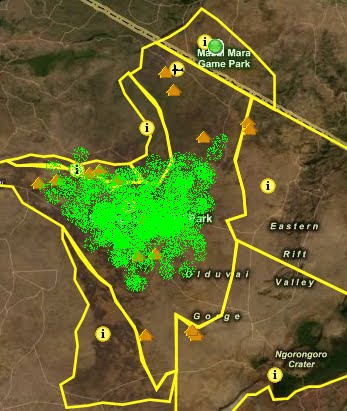
This season has seen unusual rain patterns. Rains have continued on through May, which is very unusual. This has meant that the wildebeest remained in the southern Serengeti (around Ndutu) until later than usual. As can be seen by the migration map, they are now spread out across a wide area of the Serengeti. Some small herds have crossed the Grumeti River (western Serengeti), other have gone directly north toward Lobo, while the large bulk of the wildebeest and zebra are in the central Serengeti (Seronera).
The general movement tends to be west through June (towards Grumeti) and then north into the Masai Mara (July/August), but with the good rains the wildebeest can find grazing across a much wider area this season.
The Grumeti River crossing has not yet kicked off properly, but safari guides are expecting this to happen in the coming week(s).
Friday, April 9, 2010
Rains keep the migration around Ndutu
The decent rains over the past month has meant that the short grass plains around the southern Serengeti are still able to feed the herds. They will stay here until they are forced to move due to the lack of grazing. The "norm" is that the wildebeest would already have started moving in large numbers, but in the past few years this has been happening later than normal. We are still waiting for the main migration to start moving west and north west, but for the moment they remain around Ndutu.
Safari guests have been enjoying superb gameviewing with predators enjoying the abundance of wildebeest and their vulnerable foals.
Safari guests have been enjoying superb gameviewing with predators enjoying the abundance of wildebeest and their vulnerable foals.
Monday, March 1, 2010
Rain in Ndutu
There has been a lot of rain around Ndutu, Masek and the Ngorongoro slopes. This is keeping the main wildebeest herds in the southern Serengeti. There are lots of foals getting stronger for the journey north.
A safari at this time of year is always challenging as the roads are muddy and a number of them have been closed by the rangers. Game viewing is excellent with huge herds across the plains and plenty of predators tracking them.
The best place to be based is for a safari is around Ndutu, Kusini or Seronera.
Wednesday, February 24, 2010
Herds starting to head towards Grumeti
Small pockets of herds have started moving west towards the western corridor of the Serengeti. The main herds are still in the Ndutu area, but will also start moving in the coming weeks. They normally head west or north west (towards Seronera) around this time.
Friday, January 22, 2010
Calving season in the Serengeti

This is the rainy season in the Serengeti and this season has seen its fair share of rain. The southern Serengeti is green and lush with excellent grazing for the wildebeest herds. There are literally wildebeest as far as the eye can see on the Ndutu Plains. The herds stretch from Oldupai in the east, Ndutu and towards Seronera, the Golini Plain and Lake Masek.
This is calving season in the Serengeti and there are young foal everywhere. The wildebeest pick this time of year to foal as the conditions are perfect with lots of lush grass and water. The foals will have a month or two to gather their strength before beginning to long migration north to the Masai Mara.
Due to the heavy rains, the ground is muddy and moving around is hard going. A safari at this time of year is challenging with a lot of tracks too muddy to traverse. It can be a rewarding time for the safari die-hards as you will have the Serengeti to yourself. But expect rain!
The best safari camps to be based at are the permanent camps rather than tented camps - for obvious reasons - the tented camps can get quite muddy without permanent footpaths and structures. Having said that, a number of mobile operators do do a great job in setting up robust camps.
Recommended locations include: Seronera, Ndutu
Monday, June 22, 2009
Migration Update 2009: Central Serengeti
We would like to clarify the post from 16 June 2009. This was a comment from one of our readers who has just returned from the Serengeti. I thought it was interesting so included it. The comments were probably based on individual and personal conversations with guides. As always, opinions on where and how the migration moves is very subjective and can change quickly with a change of weather or any number of factors. The truth is: No one really understands exactly how the migration moves and any prediction is only that.
The Masai Mara is not only dependent on the Serengeti herds for the migration. Herds also migrate from other northern areas of Kenya (e.g. Loita Plains) and there are resident herds that remain in the northern migration region of the eco-system throughout the year. There will almost certainly be a large migration in the Masai Mara this year, but the exact timing is debatable. The herds from the Serengeti may arrive later this year than in 2008, as conditions have meant they are staying in the central Serengeti longer this year. But, who knows for certain?
Thanks for your comments and please keep them coming. Any first hand experience in the area is also highly valued.
Wednesday, June 17, 2009
Migration News: Central Serengeti
Feedback from a reader that was in the Serengeti:
Last week they were in central Serengeti - just south of Seronera.
We travelled down from Grumeti Sunday 7th & Tuesday 9th - about 3.5 hours each way.
Grumeti are not expecting to see them until mid-July & there was talk that they might not reach Kenya at all this year.
Last week they were in central Serengeti - just south of Seronera.
We travelled down from Grumeti Sunday 7th & Tuesday 9th - about 3.5 hours each way.
Grumeti are not expecting to see them until mid-July & there was talk that they might not reach Kenya at all this year.
Subscribe to:
Posts (Atom)